
Tag: Alumni
Navigating the Mysteries of our Faith: A Journey with Saint Thomas

Whenever we take the time to look up and quietly gaze at the night sky, our hearts are almost inevitably drawn to deeper questions about reality, truth, and our place in the universe. In a recent Apostolic Letter, Pope Leo XIV , spoke of “Catholic educational constellations,” (Feb., 12, 2026) stars by which we can navigate our lives with hope. Gazing upon the truth, we are able to expand our understanding of reality, and come to a more intimate relationship with God who is Truth.
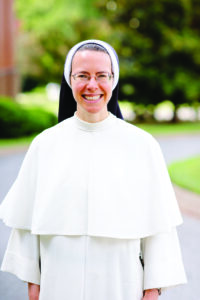
While the night sky opens our hearts to wonder, a seasoned star-gazer increases our appreciation of the intricacies of the heavens. For Sister Agnes Schreck, a Dominican Sister of Saint Cecilia, studying the works of Saint Thomas Aquinas increased her delight in and understanding of God and the mysteries of the faith. As a 2024 graduate of the Master of Arts in Thomistic Studies program at PFIC, Sister Agnes found immense joy in having time set aside to ponder the deeper mysteries of the faith and some of the more theologically complex questions.
Sister Agnes remembers that one professor described studying the truths of the faith as “developing an interior monastery” wherein one becomes oriented to the truths of the faith and how they are connected to each other. The principles are easier to access because they are interwoven within and integrated into the person. By studying the mysteries of the faith through the synthesis of Scripture and the Church Fathers provided by Aquinas, she explained that one can more easily develop an interior map or orientation to these sacred truths.
The Thomistic Studies program is an intensive journey, designed over four consecutive summers, yet Sister Agnes found it deeply renewing to study alongside other religious and laity. The summer courses helped Sister to to prepare for her apostolic work as well.
Working with university students in the Netherlands, she sees that they are bolstered by an approach to faith that shows that faith is not contrary to reason. They love learning the coherency of the faith. Previously, she taught middle schoolers. She noted that middle schoolers in particular raise objections and exceptions. Through her summer studies, she could see that these questions have been perennially asked, and that the great minds in the Church have pondered these questions. “There became rooted in me a deeper peace in the beauty of the deposit of our faith and reverence for the mysteries of our faith. I had more confidence to articulate and apply the principles I had studied.” The gift of study allows us to, in turn, be able to bring to hope to others who are seeking the Truth.
Sister was delighted to study Saint Thomas more deeply not only because she is a Dominican, but also because he had a special devotion to her own patroness, Saint Agnes. She shared that, in Father Torrell’s first volume on Saint Thomas, he explains that Thomas prayed for the healing of his assistant, Father Reginald through her intercession. When Father Reginald was healed, Saint Thomas asked that each year on the Feast of Saint Agnes, there would be a celebration feast. He also carried her relics around with him.
The “interior monastery” that Sister Agnes built through her studies helps her to see the fruitfulness of asking questions and being in dialogue with the teachings of the Church. Like the constellations in the night sky, the truths synthesized by Saint Thomas Aquinas remain fixed and bright, offering a reliable map for anyone seeking to navigate the mysteries of God with both reason and wonder.
From Blueprints to the Summa: Building the Kingdom with Saint Thomas Aquinas
For some, the phrase “rigorous academic study” sounds intimidating; for Sister Theresa Joseph, O.P., it was an invitation. In a recent conversation with Sister Theresa Joseph (STB ’23), I was struck by her frequent emphasis on the academic intensity of the Pontifical Faculty of the Immaculate Conception (PFIC). Rather than finding this daunting, Sister experienced it as life giving and life transforming. “I didn’t begin advanced studies to become an intellectual guru,” she explained, “but in order to live my religious life better.”
For Sister, the Dominican Friars’ approach elucidated that study is a formative act: when the intellect is rightly informed, it transforms the entire person. By upholding high standards, the professors didn’t just offer a grade; they offer the authentic teachings of St. Thomas Aquinas, and they ask the best from their students, a gift she grew to appreciate precisely because of the challenge it required. She also had always wanted to study the Summa, and knew that she could receive that at DHS.
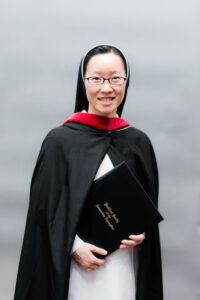
Sister Theresa Joseph Anh Nguyen is a perpetually professed member of the Dominican Sisters of Mary Immaculate Province, located in Houston, TX. She recently shared her journey of studies at the PFIC, as well as where she is currently assigned. Before becoming a Dominican Sister, Sister Theresa Joseph studied architecture as an undergrad and then earned her Masters in Business Administration. She was planning on becoming a construction or project manager. However, the Lord had other plans for her, as she explained: “I became employed by the Lord, to build His kingdom one student at a time.”
While Sister had long desired to study Scripture and teach at the University, it was not something her community has typically been engaged in as an apostolate. Sister was happily satisfied teaching PK-2nd grade religion, and forming young souls in the faith. In what Sister recognizes as Divine Providence, a series of events happened during the time of the pandemic in which a variety of assignments were simply not coming to fruition, and so her Superior decided that perhaps advanced studies would be an option.
When researching institutions, the PFIC stood out as the only option offering consistent in-person classes—a priority for Sister, despite the lack of a local community in D.C. Sister elaborated on her preference for in-person classes. Drawing on her experience from teaching the Catechesis of the Good Shepherd program, she believes that students learn better when all the senses are engaged and when they have a relationship with the teacher. “Virtual programs can hinder serious learning,” she asserts, “because the absence of a personal relationship with the teacher affects how the material is received.” For her, being physically present in the classroom fostered a deeper level of commitment, exchange of ideas and a more fruitful reception of the Dominican charism.
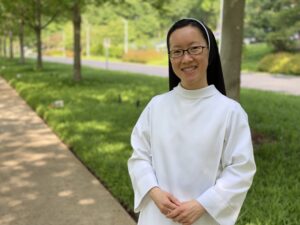 Sister Theresa Joseph is currently writing her tesina towards an STL degree in Biblical Studies at the Catholic University of America, building on the Thomistic foundation she received at the PFIC. She is exploring the topic, “Mary and the head of her enemy.” She remembers even from her childhood seeing statues of Mary, standing on a serpent. Now, she is grappling with how Mary participates in our redemption. Is the image of her crushing the serpent’s head merely a pious devotion? Sister uses Aristotelian and Thomistic principles as building blocks to answer this question. She explained, “As Christ’s humanity serves as a conjoined instrument of His divinity in the salvation of humanity, so is Mary an instrumental cause in Christ’s redemptive work. Her Fiat at the Annunciation, her motherhood at the Incarnation, and her intercession at Cana initiates the chain of causes that moved Christ to Calvary, the place where the head of the serpent is crushed.”
One of the greatest gifts Sister took from the PFIC was a unified theological picture. Though she had taken theology courses before, she had a hard time seeing how everything connected and fit together. Studying the Summa Theologiae systematically—moving from the Trinity to creation, the human person, Christology, Sacraments, and finally to Eschatology—allowed the pieces to click into place. Now, she is eager to share this holistic vision with her future students, helping them realize their full potential as Catholics.
“My intellect was formed and my spiritual life was transformed,” she says. “I realized that what I do as a moral human person is part of God bringing me back to Him.” As Sister’s own patroness Saint Thérèse, would tell us,
All the saints have understood and in a special way perhaps those who fill the universe with the radiance of the evangelical doctrine. Was it not from prayer that St Paul, St Augustine, St John of the Cross, St Thomas Aquinas, Francis, Dominic, and so many other friends of God drew that wonderful science which has enthralled the loftiest minds?
It is first through a life of prayer and for the sake of loving God, that the intellectual studies become fruitful. This contemplation allows us to gaze on Christ, and Sister Theresa Joseph is now once again contemplating Christ with Mary, as she further engages in her tesina writing.
Sister shared that when she expressed gratitude to her Superior for the gift of further study, her Superior responded: “Study is a gift for your religious life and for the community.” The fruits of these studies are truly not just a gift for oneself, but for the hope of the world. May we all be granted the grace to learn to better appreciate the gift of contemplating the truths of our faith, through prayer and diligent study!
1 Thérèse. Story of a Soul : The Autobiography of St. Thérèse of Lisieux. Second edition. Washington, D.C.: ICS Publications, Institute of Carmelite Studies, 1976. (Ms C, 36r).
Studying in Service to the Church for the Renewal of Religious Life
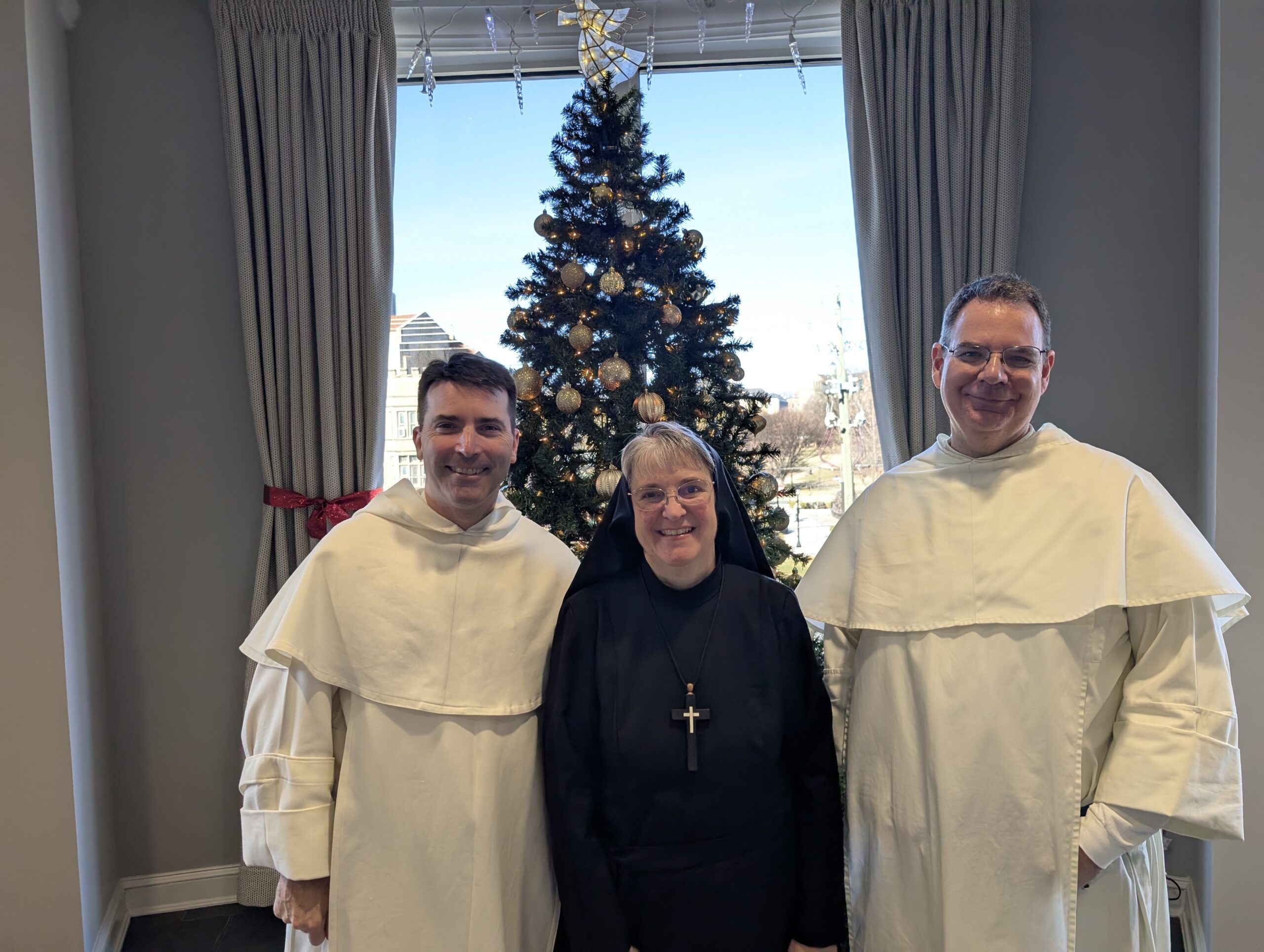
In December 2025, Sister Mary Joanna Ruhland, a perpetually professed member of the Religious Sisters of Mercy of Alma, MI, successfully defended her doctoral thesis, “The Renewal of Religious Life as a Path of Deification: A Thomistic Approach.” Following her defense, Sister Mary Joanna reflected on her time at the Pontifical Faculty of the Immaculate Conception (PFIC) and how the program has formed her for future service in the Church.
For consecrated religious, the decision to pursue studies often emerges from a dialogue of obedience. Sister Mary Joanna noted that her community chose the PFIC not only for its fidelity to the Magisterium but for its rigorous academic standards. A unique aspect of studying at PFIC is that the asceticism and discipline of study is integrated with living a life of grace through the sacramental life and contemplation of truth. She emphasized that the faculty views intellectual development as the “heart of the spiritual life.” This does not mean that one needs to be brilliant to be obedient in religious life, but that obedience as an expression of loving God with one’s whole heart, mind, and soul means using our God-given rational faculty to know Him and love Him as perfectly as possible. In relation to the intellectual life, Sister said, “DHS’s mission to cultivate every student’s inclination toward truth means that they are dedicated to help students recognize errors of thought that have led oneself or others away from God as First Truth. My dissertation contrasted a proposal for the renewal of religious life that inherently contained errors about the moral life, and, because religious life is the fullest expression of the moral life, about religious life. Recognizing these errors help us become more like God and in closer union with God by the perfection of our love for God. This deification prepares us to enjoy a most perfect union with God in heaven.”
She offered particular praise for the library staff, specifically Father John Martin. “As a religious, Father John Martin understands the vow of poverty that we make” she explained. “Voluntary poverty is not an obstacle to the intellectual life (which, again, is at the heart of the spiritual life). Rather, it is a particular approach to if and how we possess and use the material goods of this world; this approach is shaped by a greater good, namely, the divine good by which God blesses us, and the common life we share with others in the Church and in our religious community.” She described the staff as gracious and tireless in their willingness to help her locate necessary resources, especially when she was living in another country and didn’t have immediate access to the library.
When asked if she gained new perspectives on Catholic theology, Sister highlighted the “architectonic” nature of Aquinas’ sacred teaching. Sister elaborated: “My doctoral studies helped me understand St. Thomas Aquinas’ sacra doctrina (sacred teaching) in a new and deeper way. St. Thomas Aquinas has a comprehensive vision of human life, not just “from womb to tomb,” but from creation to eternal life. His threefold vision of nature, grace, and glory, teaches that we are created by God for a particular end or purpose (namely, to enjoy eternal life with God in glory), and that we are created with a capacity to participate in our journey to that end. St. Thomas Aquinas considers our path of growth and development in terms of nature, grace and glory. We can be progressively united to God because our nature is created with a capacity to receive the grace of God. By this grace, and with our cooperation, our love for God and others is perfected. By this perfection or development, we are prepared to, God-willing, receive the beatific vision of God in heaven. When St. Thomas Aquinas teaches that religious life is a state of perfection, he thinks of this perfection in terms of our nature’s capacity to be deified (made like and united to God), how the grace we receive from God through the sacraments, virtues and Gifts of the Holy Spirit deifies our nature, and the fulfillment of this perfection in glory.”
This Thomistic vision has prepared her for whatever service is asked of her in obedience. Sister Mary Joanna recalled that during the application process, the Doctoral committee asked why she wanted to study for a doctorate. In considering this question, she realized that knowledge is not sought for its own sake, but for service, and she wanted to make an academic contribution in service to the Church, particularly for religious life – to help develop the theology of religious life in the Church.
Her education now allows her to speak with greater clarity to people of all ages. Whether giving vocation talks, teaching seminarians, or speaking with priests or consecrated religious, she can explain how religious life fulfills the mission of the Church and use Thomistic principles to address contemporary errors. She is able to articulate the unique privilege of a woman religious: a consecration that is a “total offering” where love is purified and the bond with God is strengthened.
Ultimately, these studies have prepared Sister Mary Joanna to help others recognize God as the First Truth. “God created each of us to one day know supreme happiness by enjoying him in eternal life. He wants us to be involved in our own growth in grace and charity; we know this because God sent his Son, Jesus Christ, to give us this grace and show us the way to eternal life.” She concluded, “What greater love can we find?”