
Tag: Bible
Life as God Sees It

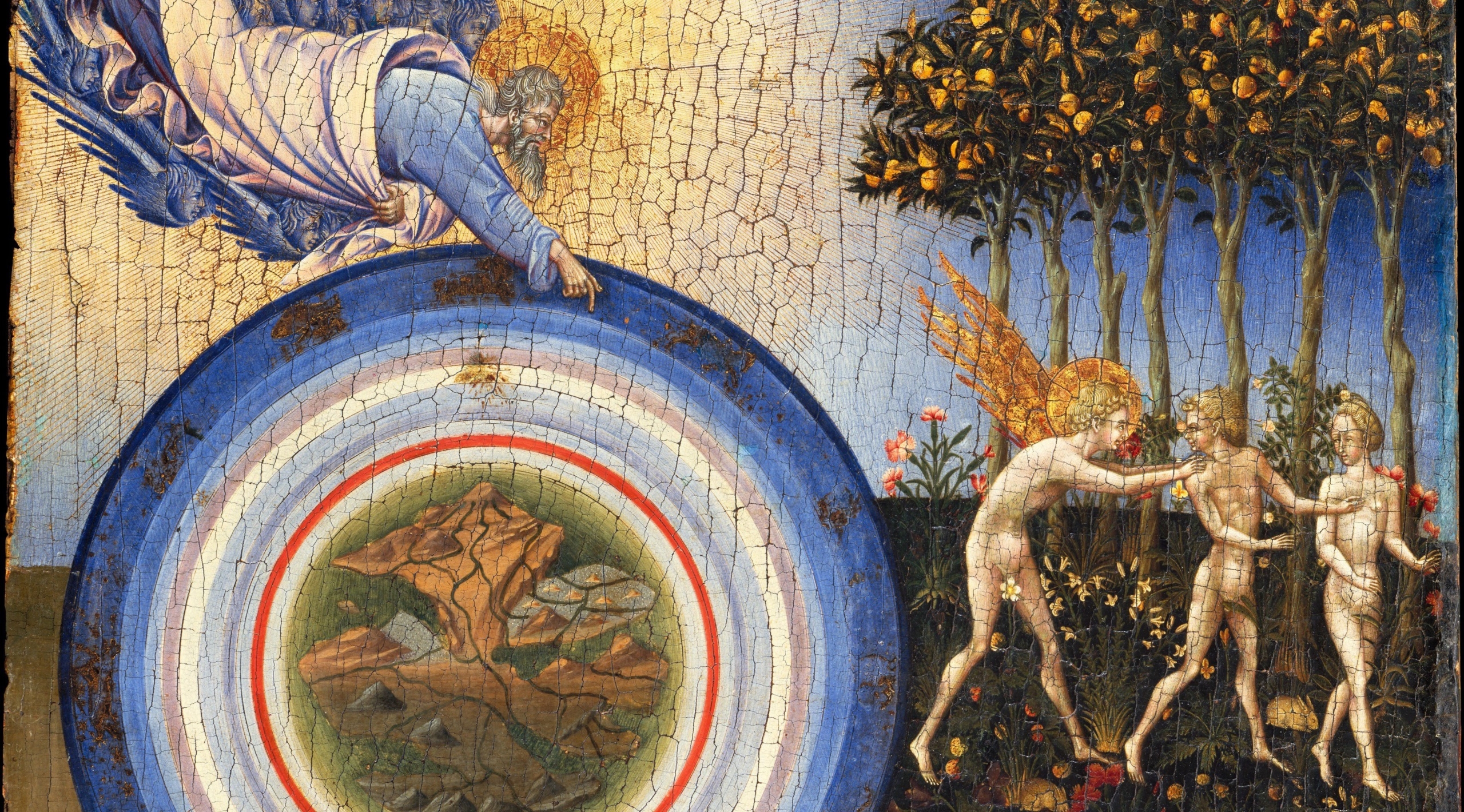
For four thousand winters Adam lay bound, bound by death, bound in death. So the medieval English hymn Adam lay ybounden has it. Not much is known about the hymn other than the parchment it is preserved on and speculations of its provenance. That is enough for our purposes. The one who hears it is pulled backwards to the beginning of recorded time, when Man deprived himself of Paradise. Now you shall be as gods (cf. Gen 3:5). Then a brother is murdered out of envy over his proper sacrifice (cf. Gen 4:3–8). The next moment: rain pours down and the deep wells up, drowning the world (cf. Gen 7:11). And in the blink of an eye: a man from Ur hears a call from a god he knows not (cf. Gen 12:1).
Yet this is not some mere record of change or an attempted retrieval of irretrievable moments. For God, all time is as one, and every single story ever lived in its truest form is known to him. God is not the god of the dead but the living (Matt 22:32). And only in God can we truly hope to see the glimpses of the eternal bearing of every free choice—for God meant it for good (Gen 50:20). We can see the meaning of history in our lives only in faith.
In this light, then, we may know that God saw the prostitute Rahab as a woman of ill-repute and as a woman predestined to save Israel: a sinner called to repentance by grace, for Joshua saved her and her family, brought her into the children of election (Josh 6:25, cf. Matt 1:5). After all, the name Joshua (also written “Jesus” in Greek) means “God saves.” We see the blood of the immolated Lamb of God in the scapegoat, sent over to Azazel (Lev 16:21–22). With the Tent of Meeting, (Ex 40:34), we see the Lady’s womb in which the dust of human flesh was divinized. At the rising of the sun nature bespeaks the rising of the eternal Son of Justice, or the uplifted Host surrounded by the golden rays of a monstrance. These stories and symbols are not dead records, irretrievable, but living and effective, sharper than a two-edged sword (Heb 4:12).
Yet there are many who say instead that the winding path through the woods is our home and not a passage to our true destination: struggle against the gloom or make your peace with it, there is no hope to be found; only the outward beauty of fleeting things, our existence suffocated with our last breath (Wis 2:2). This world, for them, is the only true life. Is that so?
No, it is not. Another way is offered—one only traversed with a special sight that sees farther than the most powerful telescope NASA could ever produce. “By your light we see light” (Ps 36:9). Jesus Christ commended those who believed what was before their eyes in his day. And in our day, he rewards those who believe what is placed before minds and hearts: “today this Scripture has been fulfilled” (Luke 4:21). And for some, the Lord offers miracles that attest to the words of life (ST II-II, q. 178, a. 1, cf. Matt 11: 2–6). Blessed are they who see the signs and wonders. Yet, as was said to Thomas, more blessed still are those who have believed without seeing (John 20:29), for no man has seen what God plans for those who love him (1 Cor 2:9), what the human heart was shaped out of clay for: do you believe this? (John 11:8).
Why do our lives happen this way or that? Are they meaningless? No, everything is meaningful—radically so: every tree and stone is pregnant with meaning; every life is a story told or yet-to-be. We have at last, as we travel forward, a choice. In which light do we walk? The one that knows this forest as the only world? Or do we walk by a different light?
✠
Originally posted on Dominicana Journal on 2/10/2026.
Forgetfulness

“Josh and the Big Wall!” was one of my favorite episodes of VeggieTales. I was always frustrated with the beginning, however, when Bob the Tomato explained that the Israelites would have already gotten into the Promised Land if only they had listened to God.
When I was first learning these Biblical stories as a kid I fell in love with God, easily convinced of his love by his mighty wonders. Thus, it made no sense to me that they would disobey God, especially so soon after he had saved them from the Egyptians. “If I had been there,” I thought to myself, “If I had seen what they had seen, then I would have . . .” But the truth is, I myself was beginning to grumble in the desert.
Many years later, when I was a freshman in college, I felt called to pray but found that the Our Father was the only prayer I remembered; I just repeated it over and over again. What had happened to me?
I had forgotten God’s wonders of old. I had forgotten the Lord’s words of life. I had forgotten his goodness. I had forgotten the truth entrusted to the Church. I had forgotten all that the Lord had done for me. I found that I had turned away from my childhood faith. Forgetfulness is a tricky thing. It seems involuntary (at least it almost always seems so when we are the ones forgetting), but forgetfulness is certainly not blameless. It is an excuse, but never a satisfactory one. “Forgetting” to do my chores was never left unpunished.
And rightfully so. Forgetfulness is not spontaneous. It is gradual and secretive. I always found it easy to forget my chores when I turned myself away from my mother’s call upstairs and towards whatever game I was playing, show I was watching, or book I was reading. Certainly, Eve made it much easier to forget the divine command when she was thinking all about how “the tree was good for food, and that it was a delight to the eyes . . .” (Gen 3:6). And the Israelites, turning to their perceived misfortunes, quickly forgot the Lord’s mighty deeds and that their “God is a God who saves” (Ps 68:21).
Sin makes us forget. Sin is a “turning away” that makes it easy to forget. And it has a compounding effect, as the only way we can justify our sin to ourselves is through a forgetfulness of God—such as forgetting his presence, his love, or that he is our final end. If we were able to forget that there is a God, then we would not be reminded of the eternal consequences of our actions and we would be able to live an easy life. Men “suppress the truth by their wickedness” (Rom 1:18). And with the truth suppressed, sin is easy.
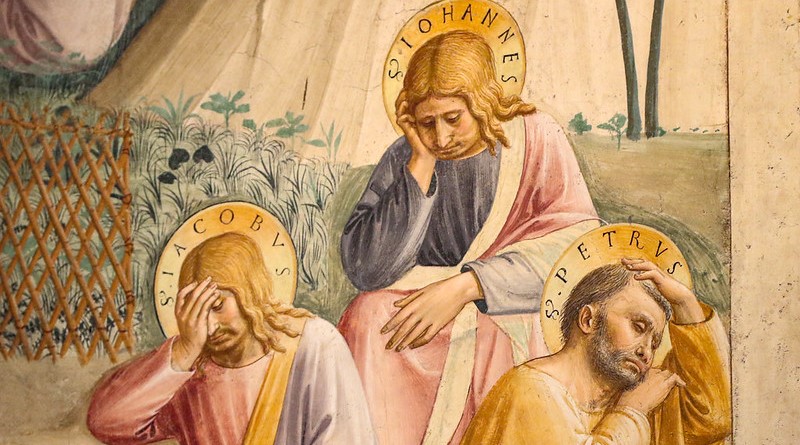
Thus, the awareness of God is essential: “there is no practice more vital to our spiritual growth; for the presence of God is indeed the very sunlight of the soul” (Anselm Moynihan, O.P., The Presence of God, 3). The saints teach us about this all-important awareness. Saint Peter is the perfect example: he sinks when he takes his eyes off Jesus (Matt 14:30). But then, after his denial, it is when the Lord “turned and looked at Peter” that Peter remembered (Luke 22:61). To be aware of God brings about the realization that he is steadily gazing upon us; that he is waiting, longing, desiring with great desire for the love only our hearts can give him. Cultivating awareness of God is nothing less than preparing for heaven. It is possible for man to forget anything if he allows his mind to go elsewhere. But you will find that it is always possible to remember again. “If you turn to him with all your heart and with all your soul . . . then he will turn to you and will not hide his face from you” (Tob 13:6).
✠
Photo by Fr. Lawrence Lew, O.P. (used with permission)
Originally posted on Dominicana Journal on 8/1/2023.
Spiritual Hunger
At a convent of the Missionaries of Charity, my mother once made twelve bags of food to give to the homeless. She and the sisters then went to one of their usual spots in my hometown to hand out the bags of food, where there were never more than twelve people. However, upon arrival my mother discovered that there were, not twelve, but thirty-six homeless. Panicking, she told one of the sisters that they should go to another spot because there would not be enough bags of food for the crowd. The sister replied that my mother should start praying the Memorare prayer. So the sisters and my mother gathered the homeless together, prayed with them, and my mother proceeded to hand out the bags of food. When the last bag was handed out, everyone had a bag in their hands.
This happened when I was a child, and because of it, the Gospel story of the Feeding of the Five Thousand has always struck a special cord in my heart. This story also seems to have hit a special cord with the Gospel writers as well, given that it is the only miracle that is recounted in all four Gospels (Matt 14:13-21, Mark 6:34-44, Luke 9:10-17, John 6: 1-14).
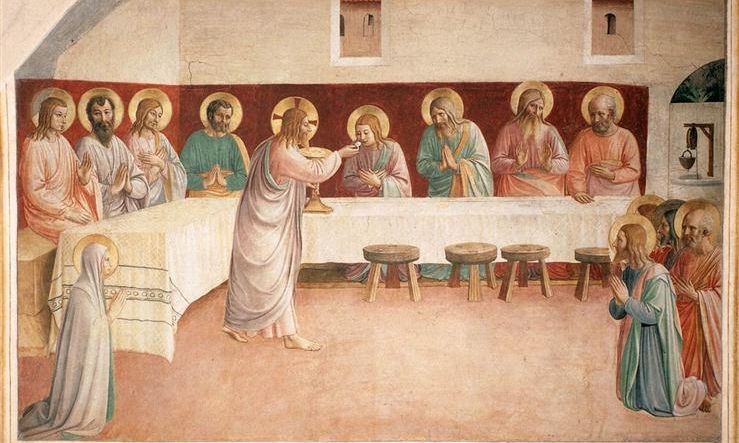
The evangelists knew the significance of this miracle story not only because the miracle itself shows the powerful and providential care of Jesus for his people, but also because of what Jesus is pointing towards in this miracle. This miracle points us to the Holy Sacrifice of the Mass, where Jesus’ sacrifice at Calvary is presented and where Jesus gives his Body and Blood to the Church as the healing food for our souls. In fact, the Book of Revelation even shows us that the same liturgy we celebrate in the Mass on earth is celebrated in Heaven. Each Mass, we should call to mind the communion of saints and angels all around us.
This all came together in the most beautiful way during one of my summer visits home. I was at mass right next to my mother. I watched as a packed congregation on a Saturday noon mass came up for communion. I couldn’t help but see us in the same light as the five thousand whom our Lord looked on with pity. Just as the five thousand were hungry for food, we were spiritually hungry for our Lord. As the apostles stood in the place of Jesus when they brought food to the five thousand, so the elderly priest stood in persona Christi as he slowly distributed the Eucharist from person to person along the communion rail.
Studying to be a priest of Jesus Christ, I can now see how, by reflecting on my mother’s miracle story, Jesus was using that event to point me to something higher. God will always look with pity on his children and will always provide priests of Jesus Christ to offer up the eternal sacrifice of Jesus for the sanctification of souls. Let us remember that every time we come to mass, we are entering into the sacrifice of Jesus for our sins and pray for a renewed spiritual hunger for Jesus in the Eucharist. Blessed are those called to the Supper of the Lamb.
Image: Fra Angelico, The Institution of the Eucharist
Originally posted on Dominicana Journal