
Tag: Lent
Lent Means More


It is somewhat ironic that Lent, the season in which we give things up and try to shed old habits, comes from the word for growth and lengthening. Obviously there’s a connection here between the growing length of the days during the spring season, but I think there’s also a spiritual significance to the idea of Lent as a season of growth and increase.
Sometimes, when the sun rises in the morning, the moon, if it is still out, fades to a spectral image in the sky. The moon fades not because the moon itself stops giving light, but because there is a much bigger show in town that’s got a corner on the light market. The same principle holds true in our spiritual lives. When we have an inordinate love for a lesser thing—Cheetos, Netflix, or whatever it might be—the way to love it less is not to strive to extinguish its draw upon us in a direct frontal assault. Rather, we should introduce another good into our lives that is so much better than the lesser good that it overthrows the tyranny of the lesser good by capturing all our attention and love. After all, dimming the moon doesn’t cause the sun to rise.
So the first step is to take stock of our lives and our loves. We can usually identify what we love by taking note of the things that we think about most and what we spend the most time trying to achieve. Then, we turn to the Lord more and more so that we really don’t have time for anything that might draw us away from him. By turning to him first, we let his goodness fill our mental atmosphere and put all other goods in their place.
Another truth about the sun-moon dynamic that I want to emphasize is that the moon only shines because the sun illuminates it. The same is true of the lesser goods in our life and the greatest good: God. When God comes into our lives in a dominant way, we realize that all good things are good only because of him. Ironically, the goodness that God distributes throughout creation becomes the center of our focus even though this goodness exists to lead us to him. Saint Augustine lamented that in his unlovely state of sin he “plunged into those lovely created things” which God had made, preferring the creation of God to the God of creation (Confessions, Book 10). In our confusion, we prefer to stumble by the light of the moon rather than to walk in the light of the sun.
And yet, although sinful, the disordered loves for created things that we find in ourselves are not completely unintelligible. It makes some sense that we are confused by the lesser lights for the very reason that we are meant to love the source of all light. If we can see the light of the sun in the moon, then we will never mistake the moon for the ultimate source of light again. Similarly, if we realize that all lesser goods are only good because of God, then we will never make them our ultimate end.
Lent is a time of abstinence, fasting, and almsgiving, in which we can release the baggage of the lesser goods that we have accrued. But it is more primarily and fundamentally a time of prayer and of growth in our attraction to the one goodness—Goodness Itself—that is the source of all goodness. And so Lent means more: more day, more light, more good, more God. As the days grow longer and the nights shorter, may our love for God increase and our love for other goods find their source in him.
✠
Originally posted on Dominicana Journal on 2/17/2026.
Lenten Joy

We find ourselves this Lenten week surrounded by a trifecta of celebratory days—this is odd. Shouldn’t we be dour? Shouldn’t we be occupied with doing penance and mourning for our sins? Were not those ashes to set us on a path of dismal gloom until the great Easter Proclamation brings it to a happy end?
To answer these questions, let us use Our Lady’s words as our guide: “My spirit rejoices in God my Savior” (Lk 1:47).
These words are repeated each day in the Magnificat of the Divine Office, and follow shortly after the Gospel selection for this Saturday’s Solemnity of the Annunciation. Within this text is contained that notion celebrated in Laetare Sunday, St. Joseph’s feast day, and the Annunciation: rejoicing.
To rejoice in God is to rejoice in his glory, manifested in all of creation. God’s work of grace in each one of us most especially manifests this glory (ST I-II, q. 113, a. 9, ad 2). To celebrate Laetare Sunday then, is to rejoice in God’s grace which purifies our souls through Lenten prayer, fasting, and almsgiving in preparation for Easter.
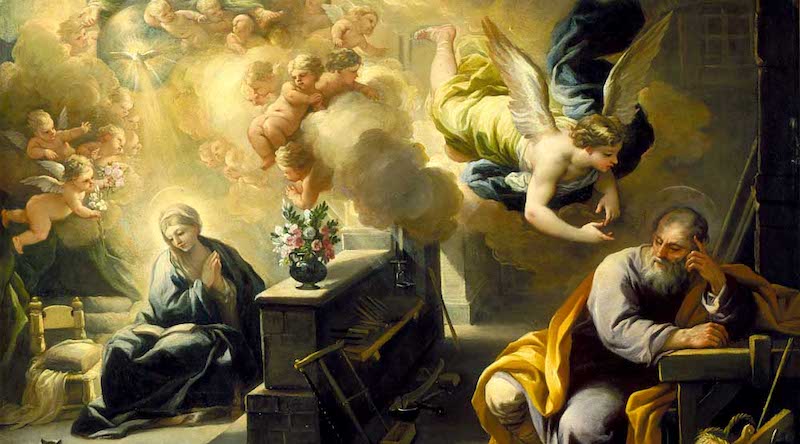
The Solemnity of Saint Joseph observed on Monday gives us the opportunity to celebrate the example of the silent foster father of the Christ child. Saint Joseph sought not his own will, but the will of God—how else could he have accepted such a strange message from the angel in his dream? He leaves us this example: finding our fulfillment in God’s will regardless of how overwhelmed, fearful, or unworthy we might feel to take it up. Saint Joseph shows that rejoicing need not consist in external jubilation, but is also fittingly expressed in silent and fortitudinous acceptance of God’s providence.
Saint Joseph’s acceptance of God’s will is beautifully complimented and fulfilled by the Solemnity of the Annunciation this Saturday, celebrating that crucial event from the first chapter of Luke. When troubled by God’s providential plan for our lives, we join Mary in her awe and questioning—“how can this be?”—and we find the same consolation in Gabriel’s reply: “nothing will be impossible with God.” Mary’s example of “may it be done unto me according to your word” becomes our prayer of rejoicing in the face of what seems to be a burden too heavy to bear.
The execution of God’s will is not without its trials, but as Saint Peter reminds us “there is cause for rejoicing here” even in our suffering (1 Pet 1:6-7). Lent dares us to add “especially in these trials.” When the going gets tough, and God has given us what seems to be too much to handle, we rejoice in the grace that he gives us to carry it out. Lent and its penitential practices allow us to come to terms with our own brokenness and unworthiness, reminded by the ashes of Ash Wednesday that we are dust, mere mortals. Yet in all this, God has made himself known, that we may carry out his will in our lives.
✠
Image: Luca Giordano, The Dream of St. Joseph
Originally posted on Dominicana Journal