- Home
- Latest Content
- Treasures of the Dominican House of Studies: A Look Inside the Rare Book Collection
Treasures of the Dominican House of Studies: A Look Inside the Rare Book Collection
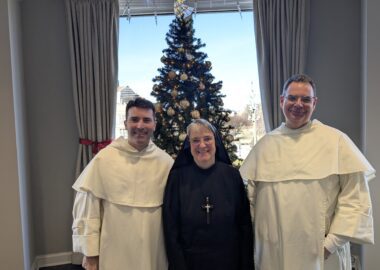
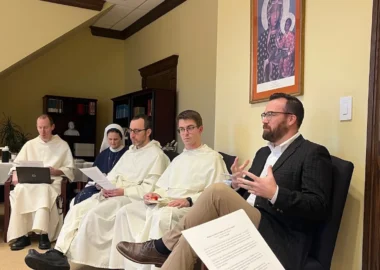
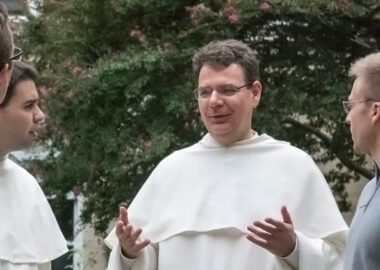
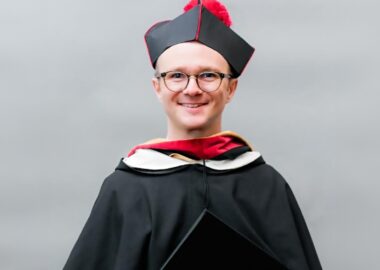
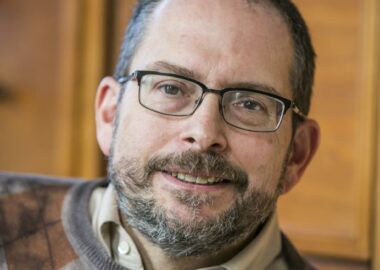
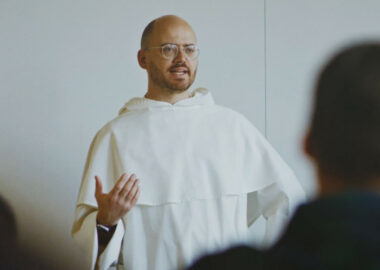
Father John Martin Ruiz, O.P., head librarian, recently explained some of the special treasures that the Dominican House library holds.
on
January 30, 2026
in
Post
The Dominican House of Studies houses a library that is “meant to foster serious and recollected study in the service of the Gospel.” Indeed, one can find in the library a quiet atmosphere of studiousness as students deepen their learning with scholarly diligence. The library acquires new books every month, but it also maintains a collection of rare books. Father John Martin Ruiz, O.P., head librarian, recently explained some of the special treasures that the Dominican House library holds.
“The library’s Rare Books and Special Collections consist of over 4,300 monographs, including 37 incunabula (books printed roughly between 1450-1500) and 23 manuscripts. These holdings are noncirculating. The rare book collection offers a treasure trove for research in history and in historical theology. Holdings include important works such as a comprehensive 17th-century edition of the complete biblical commentaries by Hugh of St. Cher (Hugo de Sancto Caro), a 13th-century Dominican cardinal, a copy of the Compendium theologicae veritatis, a copy of the Summa Theologica Moralis of St. Antoninus of Florence, early printed editions of Torquemada’s works, as well as other handbooks on trial procedure printed for the use of Inquisitors in Spain, and various contemporaneous Dominican theological responses to the Reformers.”
While many libraries hold rare books, we may ponder what the particular importance of preserving these artifacts might be within the Church. As the Holy See explains, “Thus, library documentation – archival and artistic – represents for the Church an irreplaceable means to put generations, which have encountered the Christian faith and life, in contact with everything that the Christian “event” has produced in history and in human thinking…To protect a book, encourage reading it, and its circulation is thus for the Church an activity very close to – if not to say one with – her evangelizing mission.” This resounds with the overall mission of the Pontifical Faculty of the Immaculate Conception, through study and the cultivation of the intellectual life not for the sake of knowledge, but to contemplate truth and learn how to bring that truth to others. The Holy See cautions against considering that the holdings of ecclesial libraries be considered of minor importance or a mere luxury, because they provide for a “dialogue with humanity” between cultural heritages and Christian realities. A library where future priests are studying is especially significant as it also contributes to the formation of their awareness of the universal Church.
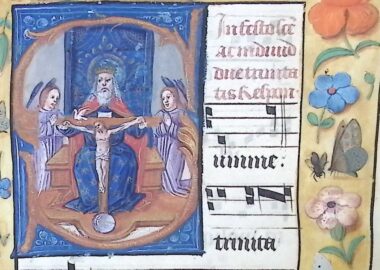
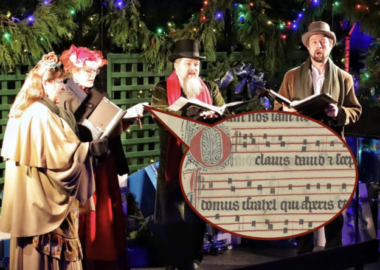
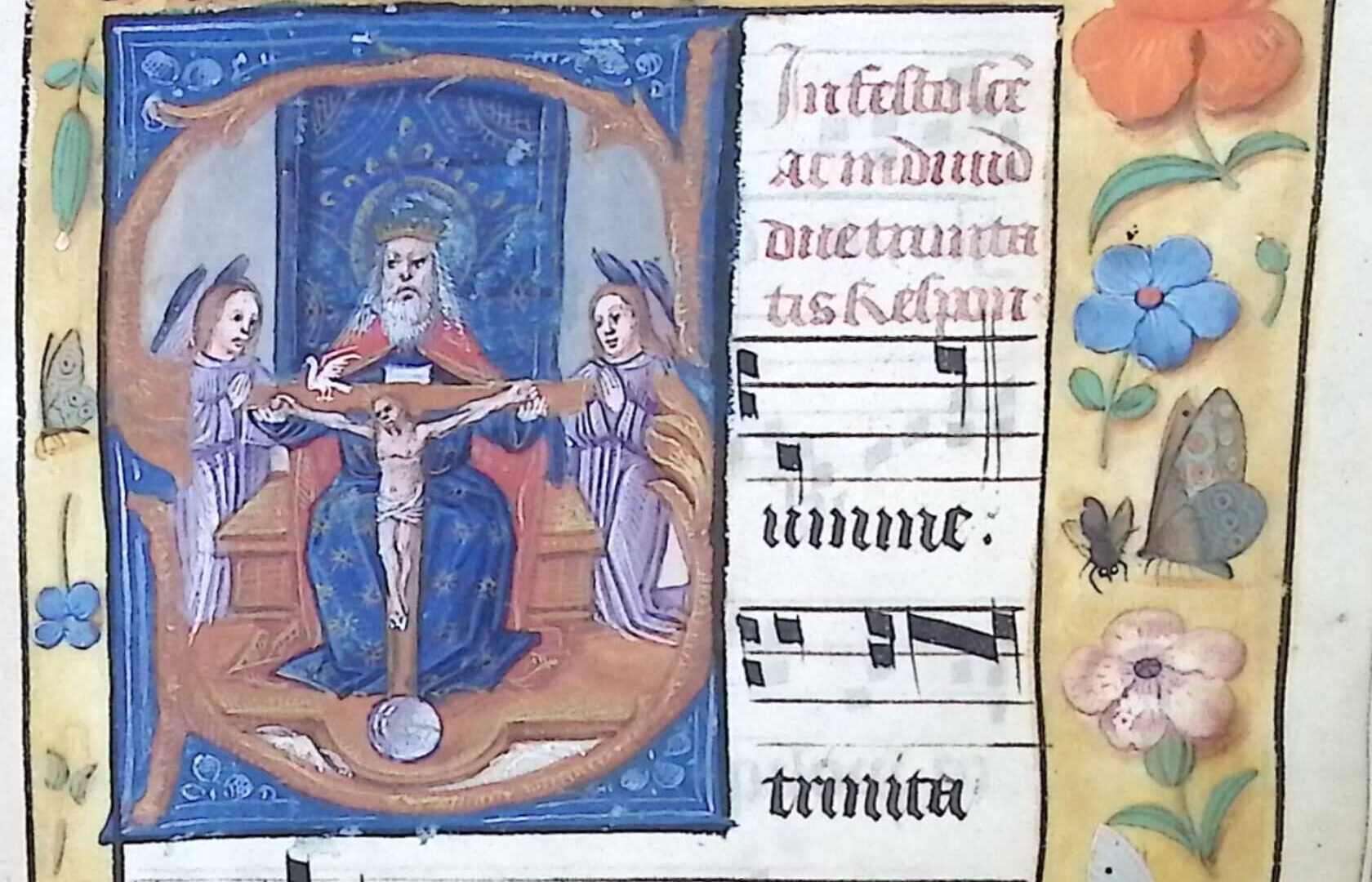
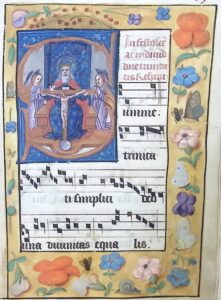
A few of the books in the collection are prayer books, including a beautifully illustrated liturgical manuscript from the 15th century, which once belonged to Father Edward Fenwick, the founder of the Dominican Province of Saint Joseph. Another is a prayer book from colonial Maryland. Preserving such works allows scholars to connect not just with history for its own sake, but also with the rich spiritual traditions, prayers, and beauty of our faith. As Catholics we know that tangible realities around us can convey our minds to transcendent realities. These prayer books, for example, are a reminder of the communion of saints to which we belong. “Faith is a treasure of life which is enriched by being shared (CCC, 949).”
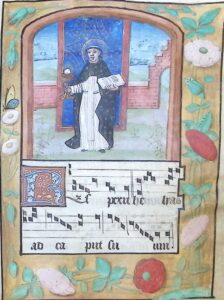
While care must be taken to preserve the rare books collection, Father John Martin and the library staff are preparing to purchase display cases so that the books can be shared on occasion with the wider DHS community. This effort responds to the call of the Holy See to share the rich cultural heritages afforded through library collections and supports the mission of the PFIC to provide ways for students to contemplate our rich Catholic intellectual heritage.